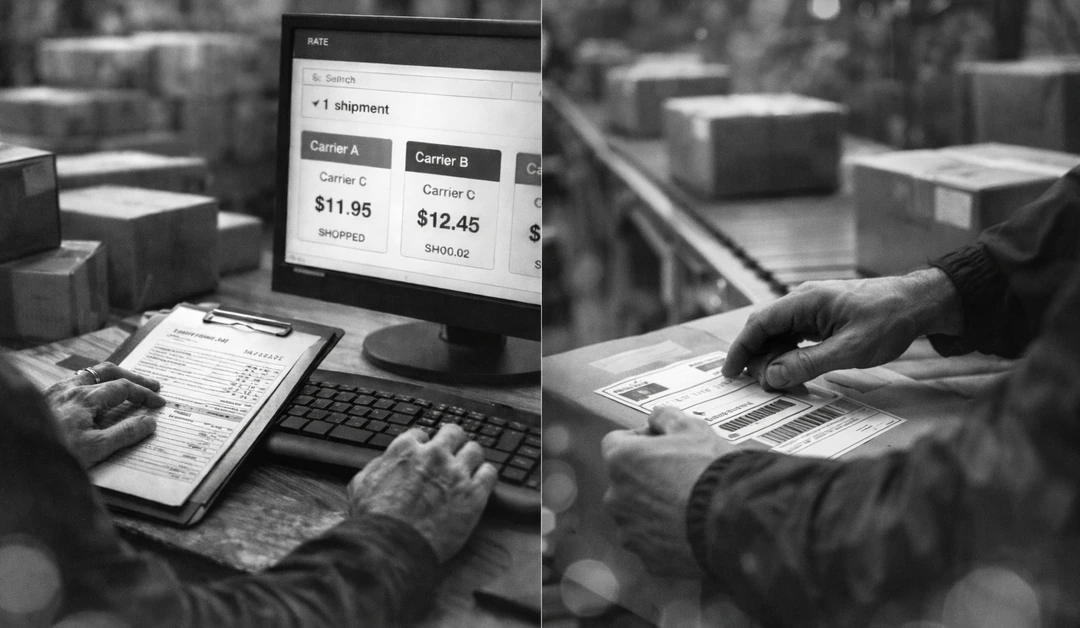


Rate shopping feels productive because it gives you an instant result: a cheaper label.
But once you are shipping at any real volume, rate shopping becomes a treadmill. You keep chasing price while the bigger cost leaks keep compounding in the background: DIM surprises, surcharges, service-level mistakes, exceptions, manual workarounds, and delivery misses that trigger refunds and WISMO.
Shipping orchestration matters more because it addresses the real problem in modern shipping. Shipping is no longer just “pick the cheapest carrier.” It is continuous coordination across carriers, services, data, packaging, and operational constraints, so decisions stay optimized as conditions change.
What changes when you ship at scale
At low volume, rate shopping can feel like a strategy.
At higher volume, it breaks because your environment is not stable:
- carrier networks shift
- surcharges change
- pickup and cutoff constraints vary by node
- regionals look great until exceptions spike
- the cost of one “temporary workaround” gets multiplied by thousands of labels
High-volume teams feel it fast. One customer put it plainly: “We are trying to figure out how to avoid human error if we have to constantly monitor and change carriers for every order.”
Rate shopping is reactive by design. Orchestration is designed for variability.

Rate shopping is a tactic. Orchestration is a system.
What rate shopping does
Rate shopping answers one question:
- “Which carrier and service is cheapest right now for this label?”
It is most helpful when:
- dimensions are accurate
- surcharges are predictable
- service levels are not tight
- operations rarely get disrupted
What orchestration does
Orchestration answers the question that actually matters:
- “What is the best option that protects the delivery promise and minimizes total cost and risk, given current conditions?”
It is a decision engine with feedback loops:
- sets eligibility based on service and risk
- optimizes total cost inside the eligible set
- applies operational guardrails (cutoffs, packaging, exceptions)
- measures outcomes and tunes logic continuously
Orchestration does not replace rate shopping. It makes rate shopping smarter by integrating it into a larger system.
The cheapest label is rarely the cheapest shipment
High-volume shippers lose margin when they optimize the label while ignoring downstream invoice and operational costs.
Here are the most common failure modes.
1) DIM and packaging turn “cheap” into “expensive”
Rate shopping cannot protect you if you are shipping air.
If dimensions are wrong or cartons are oversized, billed weight jumps and adjustments show up later. One shipper said it directly: “We need the rate shop to accurately calculate all fees, including oversize, dimensional weight, and fees for packages over a certain cubic feet.”
Orchestration connects packaging decisions to routing decisions so the rate you see is closer to the rate you pay.
2) Surcharges rewrite the economics after the label prints
Base rates are only part of the cost.
Address correction, delivery area fees, residential, additional handling, large package, and demand surcharges can erase the “win” you thought you got.
Orchestration treats surcharges as part of the decision model, not a monthly surprise.
3) Service-level mistakes create customer and support costs
Choosing the wrong service does not just risk late delivery. It creates downstream costs:
- WISMO spikes
- refunds and reships
- churn and negative reviews
- ops escalations and exception handling
This is why service-level integrity matters as much as cost.
4) Manual monitoring becomes the hidden tax
Rate shopping encourages constant switching, and constant switching creates human error, rework, and rule sprawl.
A customer nailed the real requirement: “We are looking for a report that provides visibility and allows us to remain proactive.” Another said they need a system that “tells the story of the day” so they can staff properly.
Orchestration reduces the need for constant babysitting by making routing consistent, measurable, and governed.
Why rate shopping breaks at scale
Rate shopping breaks for three reasons:
1) Shipping decisions are not only pricing decisions
High-volume carrier selection is a multi-input decision:
- delivery promise
- lane performance and scan reliability
- total cost (rate + surcharges + adjustments)
- operational constraints (cutoffs, pack flows, pickup reliability)
- risk (exceptions, claims, peak volatility)
Rate shopping typically optimizes one input.
2) Your routing logic becomes a rules jungle
When teams realize rate shopping is not enough, they often patch the gaps with rules:
- service exclusions
- lane exceptions
- “just for this SKU”
- “just during peak”
- “temporary” fixes that never go away
That is how routing becomes fragile and hard to govern.
3) Rate shopping is end-of-line thinking
One partner framed the shift well: using analytics to “make decisions earlier, rather than rate shopping multiple carriers at the end.”
Orchestration moves decisions upstream so fewer problems reach the label printer in the first place.
What shipping orchestration looks like in real operations
Here is a practical orchestration model that works for high-volume shippers and 3PLs.
1) Define the outcome first
Start with the promise:
- “delivered in 2 to 4 business days”
- “delivered by Friday”
- SLA requirements for specific accounts
2) Build eligibility sets, not endless exceptions
For each lane and promise type, define eligible services based on:
- on-time delivery performance
- scan reliability and exception rates
- claims and damage history
- operational fit (cutoffs, pickups, packaging constraints)
3) Optimize inside the eligible set
Now use rate shopping where it belongs:
- pick the lowest total cost option among eligible services
- include expected surcharges and adjustment risk
4) Add fallback logic
If a carrier becomes constrained, or performance slips, route automatically to approved alternates. No fire drill.
5) Measure outcomes and tune continuously
Track:
- “what we chose” vs “what happened”
- OTD by lane and service
- adjustment rate and surcharge dollars per order
- exceptions, claims, reships
- manual touches per 100 orders
That is orchestration: decision, outcome, improvement loop.

A simple scorecard: Rate shopping vs orchestration
Rate Shopping
- Optimizes: base rate on the label
- Works best when: the environment is stable
- Often ignores: surcharges, adjustments, performance risk
- Operational impact: more switching and monitoring
- Success metric: “cheapest label”
Shipping Orchestration
- Optimizes: total cost and delivery outcome
- Works best when: conditions change and variability is normal
- Includes: surcharges, DIM risk, performance signals, constraints
- Operational impact: fewer manual touches and escalations
- Success metric: “right service, right cost, protected performance”
Quick checklist: Are you past the point where rate shopping works?
If you answer “yes” to three or more, orchestration usually matters more than rate shopping:
- We ship enough volume that small mistakes compound fast.
- Surcharges and adjustments are a recurring surprise.
- We upgrade service levels “just in case.”
- We have multiple carriers but routing still feels manual.
- WISMO and exception spikes create support and ops chaos.
- Our routing logic requires spreadsheets to explain.
- Peak season forces last-minute changes and constant overrides.
Closing thought: shipping is a coordination problem now
Rate shopping is not useless. It is just one piece of the puzzle.
Modern shipping requires continuous coordination across carriers, services, data, packaging, performance, and operational constraints. Shipping orchestration matters more because it keeps decisions aligned with outcomes as the environment changes.